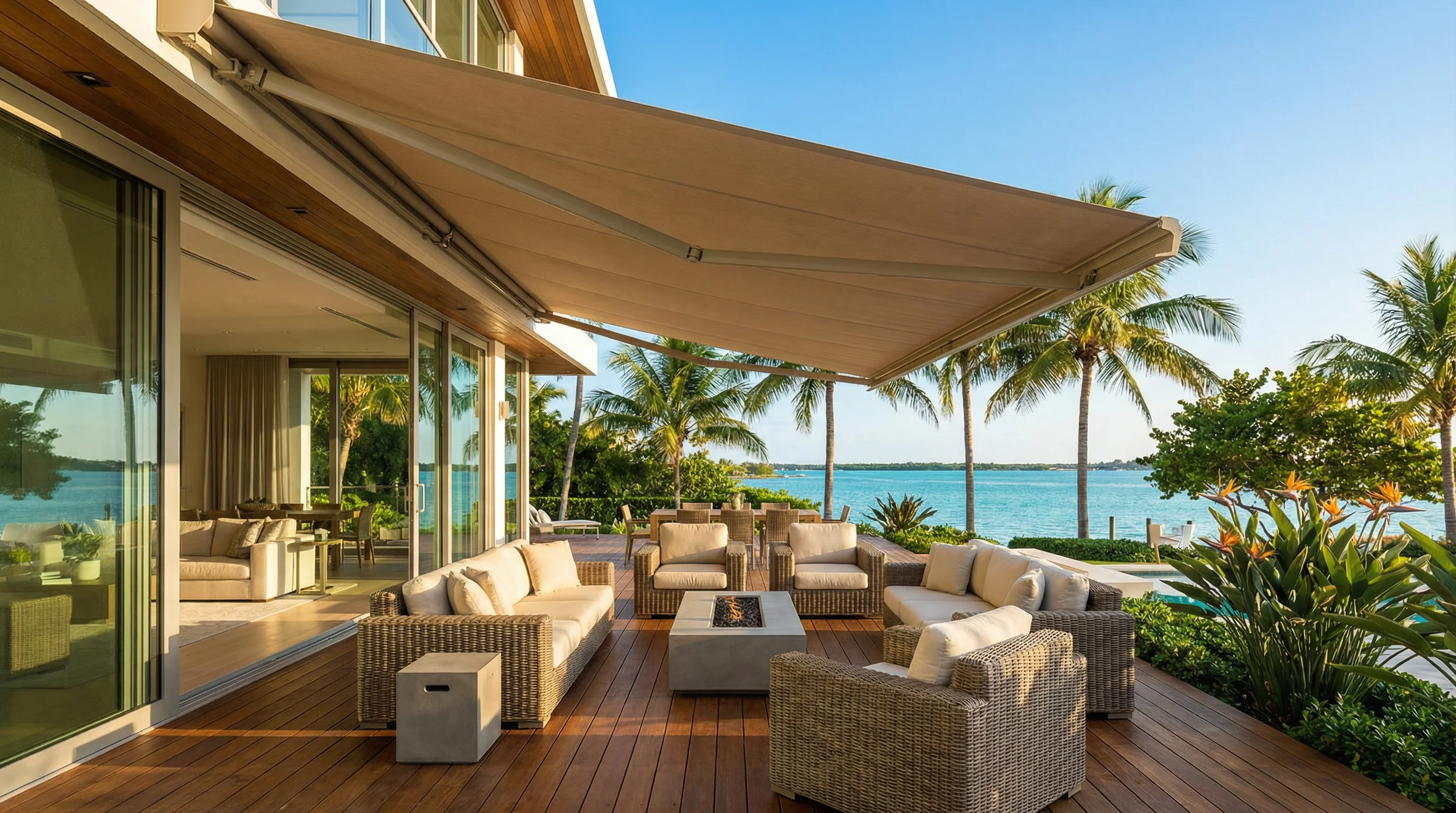
Retractable Awnings for Treasure Coast Patios: How to Actually Use Your Outdoor Space Year-Round
Treasure Coast homeowners have some of the most beautiful outdoor spaces in Florida—and some of the most underused. Learn how retractable awnings from The Shutter Factory transform patios, lanais, and decks in Stuart, Port St. Lucie, and Palm Beach County into genuinely comfortable spaces you'll use every day.
There's a pattern you'll notice in neighborhoods throughout Stuart, Port St. Lucie, and Jensen Beach. Beautiful homes with well-designed patios and lanais—and those outdoor spaces sitting empty by 10 a.m. most days.
It's not that homeowners don't want to be outside. It's that Florida's sun makes unprotected outdoor spaces genuinely uncomfortable for most of the day during most of the year. By mid-morning, a west- or south-facing patio becomes a furnace. The furniture gets too hot to sit on. The glare makes it impossible to read or use a phone. And if you're hosting guests, you're constantly apologizing for the heat rather than enjoying the gathering.
Retractable awnings solve this problem directly. For homeowners throughout the Treasure Coast and Palm Beach County, they're the difference between an outdoor space that looks good in listing photos and one you actually use every day.
Why Retractable, Not Fixed
The first question most homeowners ask is whether a fixed awning would work just as well. For Florida living, the answer is almost always no—and the reason comes down to our specific climate.
Fixed awnings provide shade in one direction at one angle, all the time. That works reasonably well in climates where the sun is consistently in the same position relative to your outdoor space. In Florida, it doesn't. Our sun angle changes significantly throughout the year, meaning a fixed awning that works perfectly in December provides inadequate coverage in July when the sun is more directly overhead.
More importantly, Florida's weather is dynamic. We get afternoon thunderstorms that arrive quickly, sometimes with significant wind gusts. A fixed awning can't retract when a storm rolls in—it takes the full force of wind and rain, which accelerates fabric wear and can cause structural damage. Retractable awnings can be pulled in within seconds when weather changes, protecting both the awning and anything beneath it.
The third factor is versatility. Some days you want full shade. Others you want partial coverage to let in afternoon light while blocking the worst of the direct sun. Some evenings you want the awning fully retracted to enjoy the open sky. A retractable system gives you that control; a fixed awning gives you one option regardless of conditions.
How Retractable Awnings Work
Modern retractable awnings mount to your home's exterior wall or soffit above your patio, lanai, or deck. The awning fabric rolls onto a cassette housing when retracted, keeping it protected from weather and UV exposure when not in use. When extended, the fabric deploys on an articulating arm system that holds it at a slight downward pitch—enough to shed rain but not so steep that it blocks your view.
Manual systems use a hand crank to extend and retract. Motorized systems—increasingly the standard choice for Treasure Coast homeowners—operate with a remote control, wall switch, or smartphone app. The motor is quiet, reliable, and typically operates on standard household electrical.
Quality motorized systems include wind sensors that automatically retract the awning when wind speeds exceed a safe threshold. This matters enormously in Florida, where afternoon squalls can arrive with little warning. A wind sensor means you don't have to monitor weather constantly or rush outside to retract the awning before a storm—it handles itself.
Sun sensors are also available, automatically extending the awning when sunlight reaches a certain intensity and retracting it as the sun moves or clouds roll in. For homeowners who want a truly hands-off experience, the combination of wind and sun sensors means the awning manages itself throughout the day.
The Fabric Makes the Difference
The awning fabric you choose determines how your outdoor space feels and how long the awning lasts. Not all fabrics perform equally in Florida's coastal environment, and the wrong choice leads to premature fading, mildew, and replacement within a few years.
Solution-dyed acrylic fabrics are the standard for quality retractable awnings. Unlike fabrics where color is applied to the surface, solution-dyed acrylics have color integrated throughout the fiber during manufacturing. This means UV exposure doesn't fade the surface because there's no surface coating to fade—the color goes all the way through. For South Florida's intense sun exposure, this distinction matters significantly. Quality solution-dyed acrylics carry 5- to 10-year fade warranties and typically last considerably longer with proper care.
Openness factor matters for awnings just as it does for solar shades. Tighter weaves provide more shade and UV protection; more open weaves allow better airflow and visibility. For most Treasure Coast patios, a balanced weave that provides 95%+ UV protection while maintaining reasonable airflow is the right choice. Extremely tight weaves can trap heat beneath the awning on still days, which defeats the purpose.
Color selection affects both aesthetics and performance. Lighter colors reflect more heat and keep the space beneath the awning cooler, but show dirt more readily. Darker colors absorb more heat but hide staining from pollen and outdoor debris. Neutral tones—tans, grays, warm whites—tend to work well for most Treasure Coast homes and hold up visually over time as styles change.
Fabric width and projection determine how much area the awning covers. Standard residential awnings range from 8 to 20 feet wide and project 8 to 14 feet from the mounting point. For larger patios and lanais common in Treasure Coast homes, multiple awnings can be installed side by side to cover the full space.
Retractable Awnings vs. Other Shade Solutions
Homeowners considering retractable awnings often compare them to several alternatives. Understanding the tradeoffs helps you make the right choice for your specific situation.
Pergolas are a popular choice for homeowners who want a permanent architectural feature. A well-designed pergola adds visual interest and can support climbing plants, string lights, and other decorative elements. However, a standard pergola provides minimal actual shade—the open lattice design lets significant direct sunlight through. Pergolas with added shade sails, polycarbonate panels, or retractable canopies address this, but at considerably higher cost than a standalone retractable awning. For homeowners whose primary goal is functional shade rather than architectural statement, retractable awnings typically deliver better value.
Fixed patio covers provide permanent, reliable shade and require no operation or maintenance beyond occasional cleaning. They're the right choice if you want maximum coverage without any management. The tradeoffs are cost (significantly higher than retractable awnings), permanence (you can't open them up on pleasant days), and the fact that they require permits and structural work that retractable awnings typically don't.
Shade sails are an affordable option that works well for some applications. They're visually appealing, relatively inexpensive, and easy to install. The limitations are that they provide inconsistent coverage as the sun moves, they need to be taken down before significant storms, and they don't have the clean, integrated look of a properly installed retractable awning.
Exterior roller shades for lanais and covered patios are a complementary solution rather than a direct competitor. Where retractable awnings extend overhead coverage beyond an existing roof line, exterior roller shades drop vertically to block low-angle sun and provide privacy on covered lanais. Many Treasure Coast homeowners use both—awnings for overhead sun control on open patios, roller shades for the sides of covered lanais.
Applications Across Treasure Coast Homes
The specific way a retractable awning transforms your outdoor space depends on your home's configuration and how you use it.
Open patios and decks benefit most dramatically. Without any overhead coverage, these spaces are often unusable from mid-morning through late afternoon during most of the year. A retractable awning creates a comfortable shaded zone that extends your usable hours significantly—you can have morning coffee outside, host afternoon gatherings, and enjoy the space through the evening.
Pool decks present a specific challenge: you want shade for seating areas and outdoor kitchens, but you don't want to shade the pool itself (which would make the water cold and reduce the appeal of swimming). Retractable awnings can be positioned to shade exactly the right area—the lounge chairs, the dining table, the outdoor kitchen—while leaving the pool in full sun. This targeted coverage is something fixed structures can't achieve as precisely.
Outdoor kitchens benefit enormously from awning coverage. Cooking outdoors in direct Florida sun is genuinely miserable, and rain can interrupt gatherings unexpectedly. An awning over the cooking and dining area creates a protected zone that makes outdoor entertaining practical rather than aspirational. The ability to retract the awning when weather clears means you're not permanently committed to a covered structure.
Waterfront properties throughout Stuart, Jensen Beach, and along the Indian River Lagoon often have spectacular views that homeowners don't want to obstruct. Retractable awnings can be positioned to provide shade without blocking sightlines—extended when you need protection, retracted when you want the full panoramic view.
Installation and What to Expect
Retractable awning installation is less involved than most homeowners expect. The process doesn't require permits in most Martin County and St. Lucie County applications (unlike permanent structures), and a standard installation typically takes a few hours.
The mounting surface matters. Awnings attach to your home's exterior wall, fascia board, or soffit. The mounting point needs to be structurally sound—typically into studs or masonry—to support the awning's weight and the forces it experiences in wind. A professional installer will assess your specific mounting situation and ensure the attachment is secure.
Electrical work for motorized systems is usually straightforward—running power to the motor location, which is often near an existing exterior outlet. In some cases, a dedicated circuit is preferable for larger awnings with multiple motors.
Color and fabric selection happens during consultation, where you can see physical samples in your actual outdoor space rather than making decisions based on catalog photos. Lighting conditions, your home's exterior colors, and surrounding landscaping all affect how a fabric looks in place versus in a showroom.
Maintenance for Florida's Climate
Retractable awnings require minimal maintenance, but the right care extends their life significantly in Florida's demanding environment.
Regular cleaning prevents mildew, which can develop on fabric that stays damp. A mild soap solution and soft brush, followed by thorough rinsing and allowing the fabric to dry fully before retracting, handles most cleaning needs. Avoid pressure washing, which can damage fabric weave and force water into the cassette housing.
Seasonal inspection of the arm mechanisms, mounting hardware, and motor (for motorized systems) catches any issues before they become problems. The articulating arms that hold the awning extended are mechanical components that benefit from occasional lubrication.
Storm preparation for motorized systems with wind sensors is largely automatic—the sensor retracts the awning when wind speeds exceed safe levels. For manual systems or as a backup for motorized systems, retracting the awning before named storms and significant weather events is standard practice.
Getting the Right System for Your Home
The right retractable awning for your home depends on your patio configuration, how you plan to use the space, your aesthetic preferences, and your budget. These aren't decisions that translate well from catalog descriptions—the variables of your specific home, sun exposure, and lifestyle matter too much.
The Shutter Factory works with homeowners throughout Stuart, Port St. Lucie, Jensen Beach, Palm City, and the broader Treasure Coast and Palm Beach County to find the right solution for each specific situation. Our free in-home consultations let us assess your space, show you fabric samples in your actual lighting conditions, and provide a quote based on your specific requirements.
If you've been looking at your patio and thinking about how much more you could use it with the right shade solution, contact us today to schedule your consultation. We'll help you figure out whether a retractable awning is the right choice—and if so, exactly which system makes sense for your home.