Plantation Shutters vs. Blinds: Which Is Right for Your South Florida Home?
Plantation shutters and blinds are the two most popular window treatments in South Florida—and the choice between them comes up in nearly every home consultation we do. Here's an honest, practical comparison to help you decide which makes more sense for your home, your budget, and your lifestyle.
Plantation shutters and blinds are the two most popular window treatments in South Florida—and the choice between them comes up in nearly every home consultation we do. Both work well. Both are available in materials suited to Florida's humidity and sun. Both offer light control and privacy. The question isn't which one is better in the abstract—it's which one is better for your specific home, your budget, and how you actually live.
This comparison is written for homeowners in Martin County, St. Lucie County, and Palm Beach County who are weighing the two options. We'll cover durability in Florida's climate, light control, privacy, cleaning and maintenance, home value, and cost—so you can make a decision you'll be happy with for years.
What You're Actually Comparing
Before getting into the specifics, it's worth being precise about what each option actually is, because both terms cover a range of products.
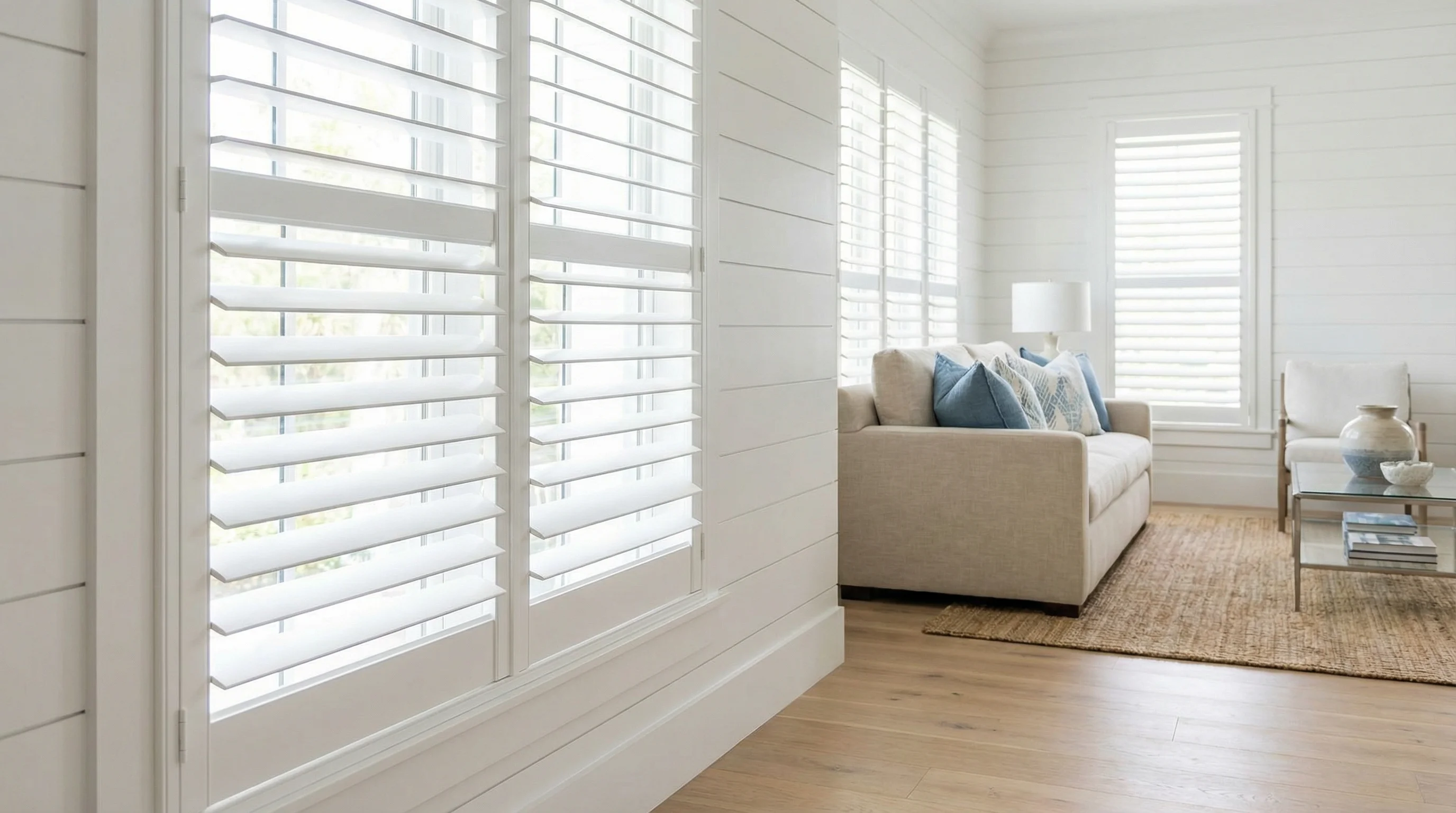
Plantation shutters are solid-panel window coverings with horizontal louvres that tilt to control light and airflow. They're mounted directly to the window frame and become a permanent architectural feature of the room. The most common materials in South Florida are composite (a wood-polymer blend), polyclad (PVC over a composite core), and basswood. Each has different characteristics for humidity resistance, weight, and appearance.
Window blinds are horizontal or vertical slats suspended from a headrail, adjusted by a cord or wand. The most relevant options for South Florida homes are faux wood blinds (PVC or composite slats that look like wood), real wood blinds (natural wood, typically basswood), and aluminum blinds. Each has different tradeoffs for durability, appearance, and moisture resistance.
The comparison that matters most for most homeowners is between composite or polyclad plantation shutters and faux wood blinds—these are the two most popular choices in the Treasure Coast and Palm Beach County markets, and they're the most directly comparable in terms of appearance and intended use.
Durability in Florida's Climate
Florida's combination of high humidity, intense UV exposure, salt air in coastal areas, and temperature swings between air-conditioned interiors and outdoor heat creates specific demands on window treatments that don't apply in most other parts of the country.
Composite and polyclad plantation shutters are specifically engineered for this environment. The materials don't absorb moisture, won't warp or crack from humidity changes, and resist UV fading significantly better than painted wood. In homes along the water in Stuart, Hobe Sound, or Juno Beach, where salt air accelerates the degradation of almost everything, composite shutters hold up exceptionally well. A quality installation typically lasts 20 to 25 years with minimal maintenance.
Faux wood blinds are also well-suited to Florida's climate—the PVC or composite construction resists moisture and won't warp the way real wood blinds do. They're a reliable choice for bathrooms, kitchens, and any room with high humidity. The limitation is that the individual slats and the cord mechanism are more vulnerable to physical damage over time. Slats can bend or break, cords fray, and the headrail mechanism can fail. A quality set of faux wood blinds typically lasts 8 to 12 years before replacement becomes necessary.
Real wood blinds are the exception: they're not well-suited to Florida's humidity and should generally be avoided in bathrooms, kitchens, laundry rooms, or any room that experiences significant moisture. If you want the warmth of natural wood, basswood plantation shutters are a better choice—they're sealed and finished in a way that provides significantly more moisture resistance than wood blind slats.
Light Control
Both plantation shutters and blinds offer adjustable light control, but they work differently and the results feel different in practice.
Plantation shutters control light through louvre angle. Wide louvres (3.5-inch or 4.5-inch are the most common in South Florida) allow significant light adjustment across a wide range—from fully open (maximum light and view) to fully closed (near-complete privacy and darkness). The louvres can be tilted to direct light toward the ceiling, which creates a diffused, pleasant quality of light even when partially closed. Shutters also have the option of bi-fold or sliding panels that open completely to one side, giving you the full window opening when you want it.
Blinds control light through slat angle and by raising or lowering the entire blind. When raised, you get the full window. When lowered with slats open, you get filtered light. When lowered with slats closed, you get privacy. The limitation is that blinds don't direct light as precisely as shutters—the narrower slats create more of a striped light pattern when partially open, which some people find less appealing in living rooms and bedrooms.
For rooms in South Florida where managing intense afternoon sun is a priority—west-facing living rooms in Port St. Lucie, south-facing bedrooms in Boca Raton—plantation shutters generally provide more nuanced and satisfying light control. The ability to tilt wide louvres to bounce light off the ceiling while blocking direct glare is a practical advantage that blinds don't replicate as well.
Privacy
Both options provide good privacy when closed. The difference shows up in the middle positions—when you want some light but also some privacy.
Plantation shutters with louvres tilted upward provide a useful combination: light enters from the upper portion of the louvre while the angle blocks sightlines from outside at eye level. This works particularly well in street-facing rooms in neighborhoods throughout Fort Pierce, Jensen Beach, and West Palm Beach where you want natural light during the day without feeling exposed to passing traffic or neighbors.
Blinds with slats tilted provide similar privacy, but the narrower slats mean the privacy-to-light tradeoff is less flexible. You can achieve privacy or light, but the range of comfortable middle positions is narrower.
Cleaning and Maintenance
This is one of the most practical differences between the two options, and it matters more than many homeowners expect when they're making the initial decision.
Plantation shutters are straightforward to clean. A weekly dusting with a microfiber cloth or a vacuum brush attachment keeps them looking good. Periodic wiping with a damp cloth handles anything more stubborn. The solid panel construction means there are no cords, no mechanisms to tangle, and no small parts to replace. In Florida, where dust, pollen, and humidity create a persistent cleaning challenge, the simplicity of shutter maintenance is a genuine advantage.
Blinds require more attention. Each individual slat collects dust, and cleaning them thoroughly means wiping each slat individually—a time-consuming process for a full set of blinds across multiple windows. The cord mechanism requires occasional lubrication and is the most common point of failure. In homes with children or pets, cords present both a safety concern and a durability concern. Cordless and motorized options address the safety issue but add to the upfront cost.
Home Value and Resale Appeal
Plantation shutters are consistently cited by real estate agents throughout South Florida as a positive feature that adds perceived value to a home. They photograph well, they signal quality and permanence to buyers, and they're a feature that buyers in the Treasure Coast and Palm Beach County markets specifically look for. In the luxury segment—homes in Palm Beach, Gulf Stream, or waterfront properties in Stuart—plantation shutters are essentially expected.
Blinds are neutral from a resale perspective. They're not a negative, but they're also not a feature that buyers specifically seek out or that agents highlight in listings. They're functional and acceptable, but they don't contribute to the perceived quality of a home the way shutters do.
If you're planning to sell your home within the next five to ten years, the resale value consideration is worth factoring into your decision. The upfront cost difference between shutters and blinds is real, but shutters retain their value in a way that blinds don't.
Cost Comparison
This is where blinds have a clear advantage, and it's worth being direct about it. Faux wood blinds cost significantly less than plantation shutters for the same window coverage. The gap varies depending on window size, material quality, and installation complexity, but it's meaningful—shutters typically cost two to four times more per window than comparable faux wood blinds.
The relevant question is whether the additional investment in shutters is justified for your situation. For homeowners who plan to stay in their home for ten or more years, who value the aesthetic and maintenance advantages of shutters, and who are treating windows in living rooms, master bedrooms, or other high-visibility spaces, shutters typically represent good long-term value. For homeowners on a tighter budget, furnishing a rental property, or treating secondary spaces like guest bedrooms or utility rooms, faux wood blinds are a perfectly sensible choice.
A mixed approach is also common and practical: plantation shutters in the main living areas and master bedroom, faux wood blinds in secondary bedrooms, bathrooms, and the kitchen. This gives you the aesthetic and durability benefits of shutters where they matter most while managing the overall budget.
A Side-by-Side Summary
| Factor | Plantation Shutters | Faux Wood Blinds |
|---|---|---|
| Lifespan | 20–25+ years | 8–12 years |
| Humidity resistance | Excellent (composite/polyclad) | Good |
| Light control | Superior (wide louvre range) | Good |
| Privacy | Excellent | Good |
| Cleaning | Easy (wipe or dust) | More involved (slat by slat) |
| Home value impact | Positive | Neutral |
| Upfront cost | Higher | Lower |
| Best for | Living rooms, master bedrooms, long-term homes | Secondary rooms, rentals, budget-conscious projects |
Which Should You Choose?
For most South Florida homeowners who are treating the primary living spaces of a home they plan to stay in, plantation shutters are the better long-term investment. The durability advantage in Florida's climate is real, the maintenance is genuinely easier, and the aesthetic contribution to the home is significant. The higher upfront cost is offset over time by the longer lifespan and the absence of replacement costs.
For secondary spaces, rental properties, or situations where budget is the primary constraint, faux wood blinds are a practical and reliable choice. They handle Florida's humidity well, provide adequate light control and privacy, and are easy to replace when they eventually wear out.
The mixed approach—shutters in the main living areas, blinds elsewhere—is how many of our customers in Martin County, St. Lucie County, and Palm Beach County end up approaching their homes, and it's often the most sensible way to balance quality and budget across an entire house.
Getting the Right Answer for Your Home
The best way to make this decision is to see both options in your actual home, in your actual lighting conditions, against your actual walls and floors. Photographs and showroom samples are useful but imperfect—the way a shutter or blind looks in a bright showroom is different from how it looks in a north-facing bedroom or a west-facing living room at 3 p.m.
The Shutter Factory offers in-home consultations throughout the Treasure Coast and Palm Beach County—we bring samples of both shutters and blinds to your home, take precise measurements, and give you a detailed quote for each option so you can make a direct comparison. There's no obligation and no pressure. Contact us to schedule a consultation, or request a quote online.